



This article focuses on how to maximize the advantages of MIDI cables and how to customize MIDI cables.
About MIDI Cables
MIDI cables connect diverse musical devices for playing and recording music.
They transmit musical data—such as note on/off, pitch, velocity, timbre changes, and clock synchronization signals—rather than audio signals.
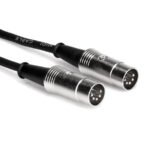
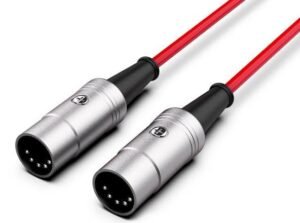
MIDI cables consist of multiple conductors and feature classic 5-pin DIN connectors at both ends.
MIDI cables can connect up to 16 channels, each linking to a different device.
Standard MIDI cables typically use shielded twisted-pair construction to effectively suppress external electromagnetic interference.
This simple technology has provided decades of stable, reliable support for music creation.
How Do MIDI Cables Work?
To grasp the importance of MIDI cables, we must first understand their operation.
MIDI cables connect the master device that sends signals to the receiving device that responds by producing sound.
MIDI data is transmitted via asynchronous serial communication at a rate of 31.25 kbps. When you press a key on a MIDI keyboard, it generates a digital signal containing information like pitch and velocity. This signal travels through the MIDI cable as an electrical current loop to another device, such as a synthesizer or computer.
MIDI interfaces are categorized as MIDI In, MIDI Out, and MIDI Thru. MIDI is a one-way communication protocol, meaning a single MIDI interface can either send or receive MIDI data.
To ensure stable signal transmission, the MIDI specification incorporates a critical hardware component: the optocoupler. It converts incoming electrical signals into optical signals and back again, effectively eliminating noise caused by looping issues.
The standard maximum length for MIDI cables is 50 feet. Exceeding this length may result in data corruption.
MIDI IN, MIDI OUT, and MIDI THRU
On any device equipped with a standard MIDI interface, you will typically find three distinct ports: MIDI IN, MIDI OUT, and MIDI THRU.
Below is a description of the functions for these three MIDI interface types.
- MIDI IN: Primarily used to receive MIDI data from other devices. For example, you can connect a MIDI keyboard’s MIDI OUT to a sound module’s MIDI IN, enabling the keyboard to play sounds from the sound module.
- MIDI OUT: Primarily used to send MIDI data generated by the device itself. Continuing the previous example, the keyboard sends the note information you play through its MIDI OUT port.
- MIDI THRU: Any data received via MIDI IN is copied and sent out unchanged through MIDI THRU. This allows a master device to connect to multiple slave devices, enabling complex device synchronization and control.
Understanding how MIDI interfaces function is essential for planning device connections effectively.
Which connectors do you use?
MIDI signal transmission is no longer limited to a single connector type.
Depending on your audio equipment or computer’s interfaces, they can be one of the following types:
- 5-pin DIN connector: The most classic MIDI connector, effectively managing communication speed between two devices. It is standard on many professional audio devices and synthesizers.
- TRS MIDI: As hardware products become increasingly compact, TRS jacks are increasingly used for MIDI connections.
- TRS MIDI comes in two types: Type A and Type B. These have distinct pin configurations that are incompatible with each other. Major brands still require adapters to connect different products when introducing new items to the market.
- Following the MIDI Manufacturers Association’s release of the MIDI 2.0 specification, Type A connectors are now prioritized.
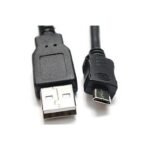
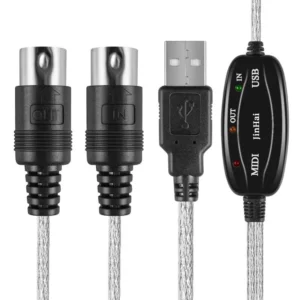
- USB: USB cables feature a USB connector on one end and a 5-pin connector on the other. As a common interface, numerous USB-to-5-pin DIN conversion cables are available to connect traditional MIDI devices to computers.
- BLE-MIDI: Bluetooth Low Energy MIDI technology eliminates physical cable constraints, making it ideal for live performances.
Advantages of MIDI Cables
- 5-pin DIN MIDI cables offer exceptional reliability and stability.
- Optical isolation design eliminates noise interference, enabling unrestricted musical creativity.
- MIDI interface devices support plug-and-play functionality. With just a computer and MIDI controller, you can directly edit and synthesize sounds on your computer.
How Can We Assist with Custom MIDI Cables?
If you’re seeking custom MIDI cable solutions, JinHai can assist. We tailor MIDI cables to connect up to 16 channels based on your requirements, ensuring optimal MIDI cable specifications.
- Precise Length: The ideal MIDI cable length is 20 feet to prevent signal attenuation caused by excessive length.
- Connector types: Select appropriate connectors based on your equipment—5-pin DIN connectors, TRS MIDI, USB, BLE-MIDI, etc.
- Custom connector profiles: Utilize right-angle connectors to fit tight spaces behind rack equipment.
- Male/female adapters: Use MIDI splitters and Y-cables to convert between male-to-female and female-to-male MIDI connections.
- Cable Color: Distinguish inputs, outputs, and pass-through connections with color-coded cables for clear visibility in complex setups.
- Shielding & Durability: Opt for enhanced shielding materials and abrasion-resistant jackets for demanding environments like touring, ensuring long-term reliability.

الخاتمة
A quality MIDI cable bridges your musical inspiration to reality. If you require MIDI cables or assistance, please consider our offerings.
جينهاي is a global manufacturer specializing in customized cable assemblies and components. We possess advanced manufacturing equipment and adhere to stringent production/process standards, strictly following the IATF16949 and ISO9001 quality management systems.
Choose JinHai to accelerate your project’s success—JinHai grows alongside your initiatives!